Updates in Wound Care: A Systematic Approach


Update In Wound Care Flyer-01

Saturday, 4 November 2017

3W’s Pavilion, UWI, St. Michael

430pm- 830pm

Objective:

To bring participants up to date on current evidence-based wound management and assessment of acute and chronic wounds, optimizing wound healing with effective wound-bed preparation, and selecting appropriate dressings. This CME will feature an interactive session exploring various solutions and treatment modalities in wound care.


Guest Speaker: Dr. Heikke Uustal, Physiatrist/ Wound Care Physician. JFK Medical Centre.


Time Topic Speaker
4.30-4.45 Current Situation: Wound Care in Barbados Veronica Webster, RN
Systematic Approach To Wound Care
4.45-5.30 Wound Healing Dr. Heikke Uustal, Physiatrist/ Wound Care Physician
5.30-5.50 Wound Assessment TBA
5.50-6.10 Negative Pressure Wound Therapy: QEH Method Dr. Selwyn Ferdinand, Surgeon
6.10-6.30 Debridement Techniques TBA
6.30-6.50 Dressing Selections Veronica Webster, RN
6.50-7.20 Offloading Techniques Dr. Heikke Uustal, Physiatrist/ Wound Care Physician
7.20-7.40 Hyperbaric Oxygen Treatment Prof. Timothy Roach
7.20-8.30 Interactive Session: Solutions and Healing: What really works? Panel


End of event – Cocktails

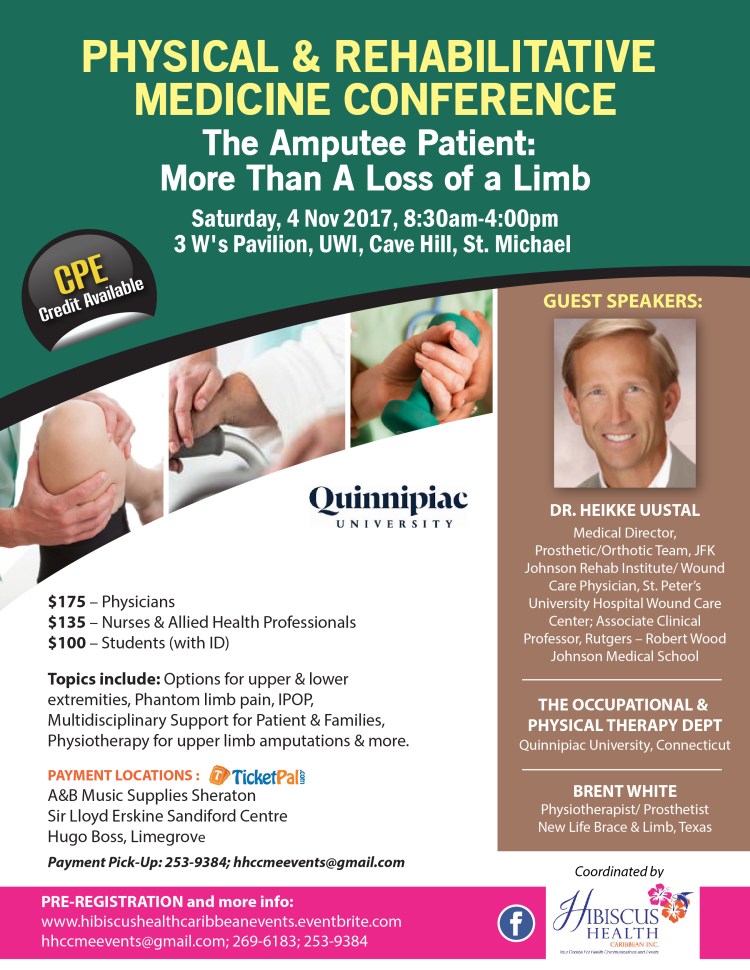
The Amputee: More Than A Loss of A Limb

Physical & Rehabilitative Conference Flyer-01

Physical and Rehabilitation Medicine Conference – Barbados

The Amputee Patient – More Than A Loss of a Limb

Saturday, 4 November 2017, 8.30AM-4.00PM

Location: 3W’s Pavilion, UWI, St. Michael

Objective: To educate the practitioner on the holistic aspect of amputations and amputee care

Guest Speakers:

Dr. Heikke Uustal

Medical Director, Prosthetic/Orthotic Team, JFK Johnson Rehab Institute
Wound Care Physician, St. Peter’s University Hospital Wound Care Center
Associate Clinical Professor, Rutgers – Robert Wood Johnson Medical School


Faculty from the Physical Therapy and Occupational Therapy Department, Quinnipiac University, CT, USA


Brent White, Physiotherapist/ Prosthetist, New Life Brace and Limb, Texas

Programme

Time Topic Speaker
8.30-9.00 Current Situation: – Why Amputation? Understanding the Barbados Mr. Selwyn Ferdinand, Surgeon
9.00 – 9.40 Options for upper and lower extremities Dr. Heikke Uustal, Physiatrist
9.40-10.20 Rehabilitation – A Team Approach: The Role of the Amputee Clinic – A Local Perspective Dr. Harley Moseley, Physiatrist
10.20-10.45 Break  
10.45-11.15 Living with an amputation: Tyrone Greene & Maxine Phillips
11.15- 11.55 Upper Limb Considerations TBA
11.55-12.45 Phantom Limb Pain Dr. Heikke Uustal, Physiatrist
12.45-1.45 Lunch  
1.45-2.25 Physiotherapy for Lower Limb Amputations Brent White Physiotherapist/ Prosthetist
2.25-3.05 Camp No Limits: Multidisciplinary Support for Children with Limb Differences & Their Families OT & PT Dept, Quinnipiac University, Connecticut
3.05-4.00 Exploring options for an IPOP (Immediate Post-Operative Prosthesis) Programme in Barbados Multidisciplinary Team

Dr. Anthony Harris; Dr. Harley Moseley, Dr. Heikke Uustal, Brent White, Paula Jordan

A Recap-Day 2 Hibiscus Health Caribbean Inc’s Women’s Health Medical Conference-Sunday Oct 29,2017

CA2FC667-0F3F-4220-A62F-5042D9748C47

The Mount Restaurant, UWI-Sunday October 29, 2017

Midwives, nurses and members of the medical fraternity were given a rare opportunity to share information about their respective fields during Women’s Health Medical Conference.

The first session started with Washington D.C based physician and OBGYN, Dr. Cortney Yarbrough who gave her presentation on Adolescent Pregnancy and Perinatal Outcomes.She also spoke about increase risk of adverse perinatal outcomes in adolescents, how to prevent them as well as how to prevent teen pregnancy.  She noted some of the challenges faced by pregnant adolescent women from a societal and medical standpoint.  . These challenges included poor social and familial support, lack of breastfeeding, adverse effects to baby (preterm labour) and getting late or sporadic prenatal care (which can lead to not being treated for certain medical conditions at an early stage).

Dr. Yarbrough was followed by Dr. Gillian Birchwood, Paediatrician and her topic was on Group B Neonatal Sepsis.  The doctor gave a comprehensive and enlightening presentation on the latest statistics globally and locally on the subject. She also highlighted the best way of testing for diseases during 35 weeks of pregnancy by performing a vaginal-rectum swab for testing.  She advocated the importance of early testing and antibiotic treatment as the best ways to prevent complications for mother and baby during and after delivery.

Other presenters included Andrea Jordan, Midwife on Alternative Birthing positions, Dr. Tracy Archer OBGYN on Intrapartum foetal monitoring and Janelle Chase-Mayers who spoke about grief recovery and foetal loss and neonatal death.


The Other Morning Sickness

The Other Morning Sickness

The news of the Duchess of Cambridge, Kate Middleton’s third pregnancy drew attention to her uncommon yet severe condition called hyperemesis gravidarum (HG).

Pregnancy can be exciting and traumatic at the same time. Some women experience skin changes, weight gain, poor circulation, high blood pressure, bone deficiency and morning sickness. The Duchess of Cambridge is part of one to two percent of women who experience hyperemesis gravidarum during pregnancy.

What is hyperemesis gravidarum?

According to the American Pregnancy Association, morning sickness affects roughly 70-80 percent of pregnant women. Hyperemesis gravidarum, an extreme version of morning sickness is a condition characterised by severe nausea, vomiting, weight loss, and electrolyte disturbance. Mild cases are treated with dietary changes, rest, and antacids. Some women may need to be treated in hospital where they receive fluid and nutrition through an (IV) intravenous line. HG is characterised by persistent nausea and vomiting which can lead to dehydration and inability to keep food down.

Cause of HG

The Association posits that it is the changes in hormone levels however the true cause is unknown.
The symptoms of the condition include headaches, severe nausea, confusion, dehydration, reduced urination, fainting, rapid heart beat, blood pressure and extreme fatigue. There is no one way to treat HG but there are several ways to manage it.

Treatment

Treatment for HG may include bed rest, acupressure, herbs like ginger or peppermint, homeopathic remedies are a non-toxic system of medicines and hypnosis. Or treatment in the hospital of intravenous lines: Nasogastric – restores nutrients through a tube passing through the nose and into the stomach and Percutaneous endoscopic gastrostomy – restores nutrients through a tube passing through the abdomen and into the stomach; requires a surgical procedure and medications, – metoclopramide, antihistamines, and antireflux medications. (KPB)


Pain During Pregnancy

Pain in pregnancy can be expected but it should not be seen as normal..

Your health provider should be notified if there is:

Vaginal spotting or bleeding
Unusual vaginal discharge
Chills or fever
Lightheadedness
Pain or discomfort while urinating
Nausea and vomiting


According to Babycenter.com, “it is not normal to have cramping during pregnancy with pain that’s severe, persistent, or accompanied by other symptoms, such as nausea, vomiting, vaginal bleeding, headache, or fever. Pain with cramps and vaginal bleeding in early pregnancy can be a sign of ectopic pregnancy or miscarriage”.


Not Normal: Pain in Upper Abdomen

It’s also not normal to have any pain in the upper abdomen. And if your abdomen is unusually sensitive to touch, especially when pressure is released, a serious abdominal infection (peritonitis) could be the culprit.

Normal: Gas, Bloating and Constipation

Gas and bloating can occur due to because of hormones that slow your digestion and the pressure of your growing uterus on your stomach and intestines.

Similarly, constipation can happen due to that change in hormones during pregnancy.

The Baby Center also notes these other situation which will cause pain.

“Cramping during orgasm: You may notice a bit of cramping during or right after an orgasm. As long as it’s mild and short-lived, it’s perfectly normal and nothing to be alarmed about.

Round ligament pain: Round ligament pain is generally a brief, sharp, stabbing pain or a dull ache that you may feel on one or both sides of your lower abdomen or deep in your groin. It usually starts in your second trimester when the ligaments in your pelvis that support your uterus begin to stretch and thicken to accommodate its growing size.

You may feel a short, sharp pain if you suddenly change position, such as when you get out of bed or up from a chair or when you cough, roll over in bed, or get out of the bathtub. Or you may feel a dull ache after an especially active day. Call your provider if this discomfort continues even after you’ve rested.

Braxton Hicks contractions: After midpregnancy, you may start to feel a tightening sensation in your uterus from time to time. Before 37 weeks, these Braxton Hicks contractions should be infrequent, irregular, and essentially painless. (Once you’re close to your due date, this type of cramping during pregnancy can be a sign of labor.)”

Source: BabyCenter.com


Nutrition and Fertility

Nutrition and Fertility

For those women who are at that stage that they want to start a family, it is important to know about how to give your body the best nutrition to conceive.

Unfortunately, many women do not have the best diet as they usually eat a diet full of processed food which consists of fat, sugar, caffeine and alcohol. When you have decided to have a baby, it will be important to focus on foods which have a high nutritional value and provide the necessary vitamins and minerals needed to ensure a good pregnancy. These changes also have to be adopted by your partner to produce healthy sperm. Therefore, habits such as smoking tobacco and marijuana should be prohibited.

Get a Nutritional Diet

For a healthy baby, it is important to eat as clean as possible. Women should eat natural food sources such as green vegetables, fruits, whole grains, lean protein such as low mercury fish and calcium enriched foods such as milk, cheese and yogurt. Foods high in zinc, iron and folic acid should be included as well. Processed foods, smoked and raw meat should be avoided.

Limited the Caffeine

Once a woman becomes pregnant, certain foods and drinks should be avoided. While the fetus is developing, doctors will advise women to stop the consumption of recreational drugs, alcohol and caffeine. Although controversial, some studies have shown that some women who were pregnant had a miscarriage due to high consumption of caffeine (NHS). However, many of these women had several risk factors such as being older, drinking alcohol or had a miscarriage in the past.

Maintain Healthy Weight

In addition to having a well balanced diet, taking the necessary vitamins and avoiding toxins or stimulants, drugs etc, it is important to get adequate sleep and exercise.Being too underweight or overweight can affect your pregnancy causing birth complications and health issues for your baby. (KPB)

Depression and Pregnancy

Depression and Pregnancy

A Reality for A Third of Pregnant Women


There is a myth that women should be always happy during pregnancy.  This is not the case as 33 percent of women can experience depression and anxiety during this period.


Mental Health Issues are often glossed over as mood swings and hormones in women.  Here are some of the symptoms of depression in women.


Symptoms of Depression

Symptoms of depression include:

Being in a depressed mood most of the time for at least two weeks
No longer enjoying the things you used to enjoy
Decreased interest in the world around you
Guilt
A sense of worthlessness
Low energy
Poor concentration
Appetite changes
Feeling hopeless
Thoughts of suicide
Getting too much sleep, or not enough sleep
The symptoms of anxiety vary by type of anxiety disorder, and include:

Generalized Anxiety Disorder:

Excessive worry that’s difficult to control
Irritability
Tension/muscle aches
Disrupted sleep patterns
Feeling restless inside
Fatigue
Poor concentration
Obsessive-Compulsive Disorder:

Recurrent, persistent, intrusive thoughts
Compulsions to relieve those thoughts through repetitive thoughts or behaviors
Panic disorder:

Recurrent panic attacks
Persistent fear of having a panic attack
Risk Factors for Anxiety and Depression

Anyone can experience depression or anxiety during pregnancy, but women with these risk factors are especially susceptible:

A personal or family history of a mood disorder, such as depression or anxiety
A history of premenstrual dysphoric disorder (PMDD)
Being a young mother (under the age of 20)
Having poor social support
Living alone
Experiencing marital conflict
Being divorced, widowed, or separated
Having experienced traumatic or stressful events in the past year
Feeling ambivalent about being pregnant
Pregnancy complications
Having a low income
Having more than three children


Treatment

Nonmedicinal Approaches
The following treatments have been shown to help pregnant women with mild to moderate depression.

Psychotherapy, such as cognitive behavioral therapy (CBT), in which a skilled therapist teaches new approaches to managing thoughts and emotions
Omega-3 essential fatty acids, which are found in foods such as oily fish and walnuts, and can act as a natural mood-booster
Light therapy, in which patients are exposed to artificial sunlight at specific times of the day to help relieve depression symptoms
Acupuncture, a Chinese practice that (in this case) involves placing tiny needles into areas of the body thought to influence mood


Some women will have to use anti-depressants to manage their condition.


Source: parents.com


Physical and Rehabilitation Medicine Conference in November 2017

The Occupational therapy and physical therapy depts of Quinnipiac Univ will be coming down to the Physical and Rehab Medicine Conference and presenting on this at the Physical and Rehab Med Conference.

Physical and Rehabilitation Medicine Conference – Barbados

The Amputee Patient – More Than A Loss of a Limb

Saturday, 4 November 2017, 830AM-330PM

Location: 3W’s Pavilion, UWI, St. Michael

Objective: To educate the practitioner on the holistic aspect of amputations and amputee care

Guest Speakers:

Dr. Heikke Uustal

Medical Director, Prosthetic/Orthotic Team, JFK Johnson Rehab Institute
Wound Care Physician, St. Peter’s University Hospital Wound Care Center
Associate Clinical Professor, Rutgers – Robert Wood Johnson Medical School

Faculty from the Physical Therapy and Occupational Therapy Department, Quinnipiac University, CT, USA

Brent White, Physiotherapist/ Prosthetist, New Life Brace and Limb, Texas

Dalton Farquhson, Vascular Surgeon, Bahamas

Draft Programme – Times and order of presentations are subject to change

Time

Topic

Speaker

8.30-9.00

Current Situation: Amputations in Barbados

Mr. Selwyn Ferdinand, Surgeon

9.00 – 9.40

Options for upper and lower extremities

Dr. Heikke Uustal, Physiatrist

10.00 – 10.20

Living with an amputation

Patient

10.20-10.40

Success Stories: Decreasing the amputation rate in the Caribbean

Dalton Farquhson, Vascular Surgeon, Bahamas

10.40-11.20

Brunch

11.20-12.00

Phantom Limb Pain

Dr. Heikke Uustal, Physiatrist

12.00-12.40

Physiotherapy for Upper Limb Amputations

Brent White Physiotherapist/ Prosthetist

12.40-1.00

Rehabilitation – A Team Approach: The Role of the Amputee Clinic – A Local Perspective

Dr. Harley Moseley, Physiatrist

1.00-1.15

Break

1.15-1.45

Camp No Limits: Multidisciplinary Support for Children with Limb Differences & Their Families

OT & PT Dept, Quinnipiac University, Connecticut

1.45-2.45

Exploring options for an IPOP (Immediate Post-Operative Prosthesis) Programme in Barbados

Multidisciplinary Team

Dr. Anthony Harris; Harley Moseley, Dr. Heikke Uustal, Brent White

2.45 – 3.30

Discussion

Closing Remarks

Chairperson

________________________________
Marrianne C Burnham, JP, BSc., PGDip
Nutritionist | Health & Medical Events Coordinator
Hibiscus Health Caribbean Inc.

Weston, St. James, Barbados, West Indies
Mobile: 246-269-6183 | Home: 246-422-4307|
email: mcburnham@gmail.com

“The single biggest problem in communication is the illusion that it has taken place.”
― George Bernard Shaw

 

Camp No Limits

About Camp No Limits

Started in 2004

Camp No Limits is the only camp for young people with limb loss & their families, creating a network of support for all the campers.  It offers therapeutic programs with specialized professionals, including physical & occupational therapists, prosthetists & adult amputee role models.

Each camp is unique, but overall there are generally five programs offered each day (see below). All activities incorporate family members as well, with specific group sessions for siblings & parents when appropriate to address the needs of families living with individuals with limb loss.

So Far the Camp No Limits has

  • 10 Camps Nationwide
  • 250 families served and 81 percent of them funded
  • In 2016, 1250 people impacted

About No Limits Foundation

No Limits Foundation is a non-profit organization 501 (c)(3) providing camps for children with limb loss, and education, mentorship, and support to these children and their families.

In first weekend camp in August 2004, hosted by Pine Tree Camp in Rome, Maine with 4 families, Camp No Limits began to take shape. Now after a snowball effect the dream has now expanded nationwide with camps in Maine, Missouri, Maryland, Florida, Idaho, Arizona, Texas, California, and Connecticut.

Diabetes Education Series Oct 25 & Nov 1, 2017

bdf

The Maria Holder Diabetes Centre of the Caribbean presents their:

Diabetes Education Series:

Part # 1: Diabetes Care Review (Paediatric Perspective) – Oct 25, 2017, 5pm-9pm

Part#2: Approach to Diabetes: Updates and Practical Tips, Nov 1, 2017, 5pm-9pm

Diabetes Centre, Warrens, St. Michael  

Suitable for nurses, nursing auxiliaries, diabetes educators, medical students, nutrition and wellness coaches, exercise therapists and other interested health professionals working with people with diabetes. Physicians are welcome to attend.

These continuing medical education events are designed to offer updates and insights into the latest approaches to patient care and strategies to effective management. In engaging with the patient, health professionals must be equipped with the appropriate information to support the patient in their medication use, care schedules and recommendations made. Understanding the intricacies of exercise and glycemic control, can make a tremendous difference when advising a patient to exercise.

Suitable for nurses, nursing auxiliaries, diabetes educators, medical students, nutrition and wellness coaches, exercise therapists and other interested health professionals working with people with diabetes.  CPE Credit will be available.

Part # 1: Carbohydrates and Diabetes Care Review (Paediatric Perspective)

Wednesday, October 25, 2017 5pm-9pm – Diabetes Centre, Warrens, St. Michael


Programme

Time Topic Speaker
5:00- 5:10 Welcome and Introduction to Pediatric Diabetes Dr. Diane Brathwaite, Diabetologist
5:10- 6:10 Understanding Carbohydrates and Nutrition Considerations In Diabetes Victoria Cox, Registered Dietitian
6:10- 7:10 Update on Pediatric Diabetes Management and Insulin Cynthia Medford, Paediatric Diabetes Specialist Nurse
7:10-7:40 Break and Dinner
7:40- 9:00 Practical Workshop Victoria Cox and Cynthia Medford

BDS$55 – All participants or $100 both events

BDS$35.00 – Students

Payment:

Online: https://secure.ticketpal.com/affiliate/hibiscushealthwebsite

Barbados:

A & B Music Supplies, Sheraton

Sir Lloyd Erskine Sandiford Centre

Hugo Boutique, Limegrove

Payment Pick-Up/ Queries: 246-253-9384; hhccmeevents@gmail.com


The Maria Holder Diabetes Centre of the Caribbean presents their:


Diabetes Education Series:

Part#2: Approach to Diabetes: Updates and Practical Tips

Wednesday 1 November 2017, 5pm-9pm

Suitable for nurses, nursing auxiliaries, diabetes educators, medical students, nutrition and wellness coaches, exercise therapists and other interested health professionals working with people with diabetes.

Programme

Time Topic Speaker
5:00 -5:10 Welcome Dr. Diane Brathwaite, Diabetologist
5:10-5:60 What can we learn from Diabetes Care Models and The Diabetes Care Plan Dr.Diane Brathwaite, Diabetologist
6:00- 6:40 Pharmacotherapy Update Dr. Laura Layne, GP
6:40- 7:20 Important Conversations and Counselling : A Diabetes Specialist Nurse Perspective Mrs. Kevamae Sobers, Diabetes Nurse
7:20- 7:50 Break/ Dinner
7:50- 8:20 Updates and Practical Tips and Advice for the Diabetic Foot Amor Forde, Podiatrist
8:20- 9:00 Diabetes and Cognition Dr. Kristyn Kirton, GP

BDS$55 – All participants or $100 both events

BDS$35.00 – Students

Payment:

Online: https://secure.ticketpal.com/affiliate/hibiscushealthwebsite

Diabetes Centre, Warrens, St. Michael

A & B Music Supplies, Sheraton, Ch Ch

Sir Lloyd Erskine Sandiford Centre, St. Michael

Hugo Boss Boutique, Limegrove, St. James

Payment Pick-Up/ Queries: 246-253-9384; hhccmeevents@gmail.com